
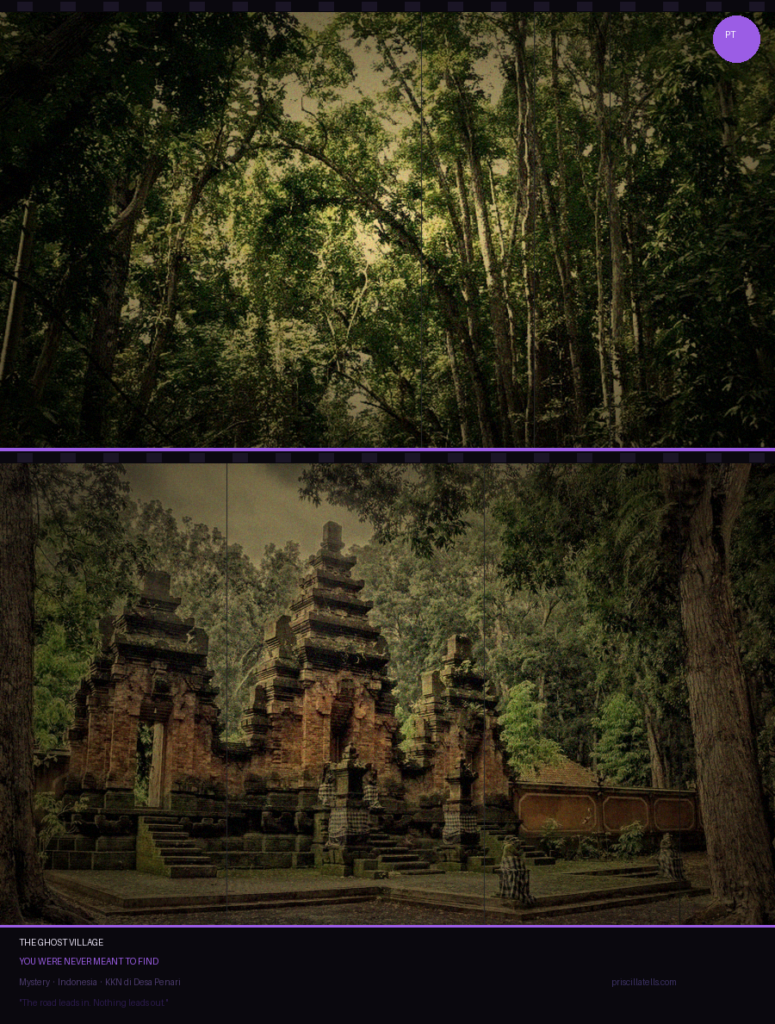
Some ghost stories begin with a house. Others begin with a road.
KKN di Desa Penari begins with a village that nobody can quite place.
That is part of its power. The story, first posted as a viral Twitter thread by the anonymous writer SimpleMan in 2019, follows a group of university students sent to a remote village for Kuliah Kerja Nyata, Indonesia's student community service program. What should have been a temporary assignment turns into a nightmare of warnings, forbidden places, unseen rules, and a dancer who seems to belong to a world older than the students understand.
The village in the story is called Desa Penari, the Dancer Village. But the real location has never been officially confirmed by SimpleMan. Names were disguised. Identities were hidden. The campus, city, and village were kept vague.
That absence did something unusual: it turned Desa Penari into a ghost village in the public imagination.
Not a ghost village because it was abandoned. Not a ghost village because it appeared on a government list without residents. But a ghost village because it existed everywhere and nowhere at once: in rumor, in speculation, in screenshots, in YouTube investigations, in late-night arguments, and in the anxious feeling Indonesians know well when a road narrows, the trees close in, and someone says, "Do not go past that boundary."
The Case
The modern case of KKN di Desa Penari is not a police file. It is a cultural case.
In 2019, SimpleMan posted the story as a Twitter thread. It spread quickly, partly because it used a familiar Indonesian frame: students leaving the city for a rural assignment, entering a place where local rules matter more than their own confidence.
The basic premise is simple. A group of students arrive in a remote village for KKN. They are warned not to cross certain boundaries and not to behave carelessly. As the days pass, strange things begin happening. Two students, often identified in summaries as Bima and Ayu, become central to the tragedy. Other students, including Nur and Widya, become witnesses to a village that seems ordinary on the surface but governed by forces they do not fully understand.
The story became a book, then a blockbuster film released in 2022. By then, the mystery had expanded beyond the plot. People were no longer only asking, "What happened to the students?" They were asking, "Where is Desa Penari?"
That second question became its own phenomenon.
Was it in Banyuwangi? Was it near Rowo Bayu? Was the forest route inspired by Alas Purwo? Was the story a composite of several places? Was the location deliberately hidden to protect the village, the source, or the writer?
No official answer settled it. That uncertainty became part of the legend.
How the Story Broke Open
The reason KKN di Desa Penari traveled so far is that it felt both specific and impossible to pin down.
The story contained recognizable Indonesian details: KKN students, village elders, local taboos, offerings, possession-like disturbances, and the idea that a place may have rules outsiders cannot see. These details made the story feel close to home.
But the hidden location made it feel larger than one village.
Once the thread went viral, readers began treating the mystery like a map. Online communities compared clues. Content creators searched for possible sites. Banyuwangi became one of the strongest public guesses, and Rowo Bayu was repeatedly discussed as a possible inspiration. Tourism articles later listed Banyuwangi destinations with a similar atmosphere to the story, including Alas Purwo National Park.
The important thing is not whether any of these places is the real Desa Penari.
The important thing is that people believed the real Desa Penari could exist.
That belief is the engine of the story.
Why a Forest Makes the Perfect Ghost Village
In Indonesian horror, the forest is rarely just scenery.
A forest is a threshold. It is where roads thin out, phone signals weaken, and ordinary social rules feel less powerful. It is also where older rules seem to wake up: rules about permission, modesty, speech, desire, offerings, sacred sites, and respect for what cannot be seen.
That is why the "village in the forest" is such a strong horror image. A village suggests community and safety. A forest suggests danger and concealment. Put them together, and the result is a place that looks inhabited but feels unreachable.
KKN di Desa Penari understands this perfectly.
Its horror does not come only from the dancer. It comes from crossing into a place where the students are guests but behave, at times, as if they are entitled to understand everything. The village is frightening because it is not empty. It is full: full of memory, hierarchy, desire, ritual, and consequences.
This is where Alas Purwo becomes a useful parallel.
The Alas Purwo Connection
Alas Purwo is not confirmed as the setting of KKN di Desa Penari. That should be stated clearly.
But as a symbolic cousin to Desa Penari, it makes sense.
Located in Banyuwangi, East Java, Alas Purwo National Park sits at the southeastern tip of Java. It is one of Banyuwangi's most famous natural landscapes, known for forest, savanna, mangrove, caves, beaches, and wildlife. Its official area is more than 44,000 hectares, and travel reporting often notes its reputation as a place associated with mystery, spiritual practice, and old Javanese stories. Its name is commonly understood as "first forest" or "ancient forest," adding to the feeling that the place belongs to a time before ordinary settlement.
Visitors may go there for nature, surfing, wildlife, or pilgrimage. But in the popular imagination, Alas Purwo also belongs to another category: the haunted forest.
That does not mean it is merely scary. The more interesting point is that Alas Purwo carries a double identity. It is a real conservation area with ecological value, and it is also a mythic landscape where people project ideas about the unseen.
That double identity mirrors Desa Penari.
Desa Penari is a village in a viral horror story. It may be based on a real place, a disguised place, or a collection of narrative elements. But the public treats it as if it is both fictional and findable. Alas Purwo is a real place, but its reputation makes it feel like a doorway into stories.
One is a hidden village people tried to locate.
The other is a known forest people already believed could hide things.
Timeline
2009, according to the story's claim The events behind KKN di Desa Penari are often said to have taken place years before the thread went viral, involving university students on a KKN assignment.
June 2019 SimpleMan began posting the story on Twitter. The thread quickly gained attention because it blended campus life, rural taboos, and supernatural horror in a way that felt unusually intimate.
August-September 2019 The story became a major internet phenomenon. Readers debated its authenticity and speculated about the real location of Desa Penari. The book version was released by Bukune in September 2019.
2022 The film adaptation of KKN di Desa Penari was released after pandemic delays and became a major Indonesian box-office success. Public curiosity about the "real" village intensified again.
After the film's release Banyuwangi locations, especially Rowo Bayu and places with a similar forest atmosphere, were discussed in media and online commentary. Alas Purwo was often mentioned not as the confirmed location, but as a place with a comparable aura: remote, forested, old, and wrapped in stories.
The People and Figures Involved
SimpleMan The anonymous writer who brought the story to the public through Twitter. SimpleMan has consistently kept the identities and location vague, which helped protect the source but also fed the mystery.
The students The students in the story function almost like archetypes: young outsiders entering a place with rules they do not fully respect or understand. Their role is why the story works so well for Indonesian audiences. KKN is ordinary. The terror begins when the ordinary assignment crosses into sacred territory.
The village elder In many versions and summaries, the village authority figure represents local knowledge. He understands the boundaries, but the students do not fully grasp the cost of ignoring them.
The dancer The dancer is the image that makes the story unforgettable. She is beautiful, dangerous, and not fully human in the way the students understand humanity. She turns desire into a trap and performance into a warning.
The forest The forest is not a person, but it behaves like a character. It encloses the village, hides the forbidden places, and marks the difference between outside logic and inside law.
Why Desa Penari Became So Disturbing
Desa Penari became disturbing because it made people feel that the old world had not disappeared.
Modern Indonesian life is full of roads, campuses, smartphones, and social media. But KKN di Desa Penari suggests that modern people can still wander into a place where those things do not protect them.
That fear is very Indonesian. It is not only fear of ghosts. It is fear of being arrogant in a place that requires humility. Fear of laughing at rules that were never decorative. Fear of treating a village like a project site when it sees itself as a living world.
The hidden location makes that fear stronger. If Desa Penari had been officially identified, the story might have become smaller. It would belong to one map point. Instead, because it was never confirmed, it became portable.
Every remote village with a forbidden path could be Desa Penari.
Every forest road at dusk could be the road in.
Every old warning could be the one the students should have obeyed.
The Larger Pattern: Haunted Forests and Hidden Settlements
Indonesia has many stories about places that are not empty even when they look empty.
Forests, mountains, beaches, caves, old kingdoms, and abandoned settlements often carry stories of invisible residents. Some are framed as spirits. Others are described as guardians, ancestral presences, jin communities, or remnants of older kingdoms. The vocabulary changes by region, religion, and storyteller, but the structure is familiar: humans share space with beings they cannot always see, and trouble begins when humans forget that.
Alas Purwo fits this pattern because it is already imagined as ancient, remote, and spiritually charged. Its real features help the myth: dense forest, caves used for meditation or pilgrimage, wildlife, long roads, and coastal edges that feel far from ordinary urban life.
Desa Penari fits the same pattern in narrative form. It is not simply a haunted village. It is a hidden settlement inside a moral landscape. The students do not just meet ghosts. They enter a system.
That is why KKN di Desa Penari became more than a viral thread. It gave modern shape to an old anxiety: the fear that there are places where the visible world is only the front room.
The Unanswered Questions
The biggest question remains the one that made the story famous: where is Desa Penari?
But maybe that question is less important than it seems.
If the location were confirmed, people would argue about accuracy. They would compare buildings, roads, trees, and travel times. The mystery would become a checklist.
The stronger question is why so many people needed Desa Penari to be real.
Perhaps because the story sits in a space many Indonesians already recognize. A remote village. A forest boundary. A local warning. A beautiful figure who is not safe to desire. A place that punishes disrespect.
The story feels real because the rules feel real, even to people who do not literally believe every detail.
Aftermath
After its viral success, KKN di Desa Penari became a book, a film, and a cultural reference point. It changed the way many people talked about internet horror in Indonesia. It also turned location-hunting into part of the experience, with audiences treating geography as an extension of the story.
Alas Purwo, meanwhile, continues to exist in its double role: protected national park and mythic forest. It is not the confirmed Desa Penari. But it helps explain why the story worked. Indonesia does not need to invent haunted landscapes from nothing. It already has places where ecology, pilgrimage, taboo, tourism, and fear overlap.
That is the real ghost village of KKN di Desa Penari.
Not a dot on a map.
An idea waiting at the edge of the trees.
Quick Case Summary
Case name: The Ghost Village You Were Never Meant to Find Main story: KKN di Desa Penari First viral moment: Twitter thread by SimpleMan in 2019 Claimed premise: University students experience supernatural events during KKN in a remote village Key mystery: The real location of Desa Penari has never been officially confirmed Common public speculation: Banyuwangi, including Rowo Bayu and forested landscapes with a similar atmosphere Parallel location: Alas Purwo National Park, Banyuwangi, East Java Important distinction: Alas Purwo is not confirmed as Desa Penari; it is used here as a cultural and atmospheric parallel Broader theme: Haunted forests, hidden villages, local taboos, and the fear of crossing into places governed by unseen rules.